para-parasocial
A few years ago, I was scrolling through Instagram when I stumbled onto pictures from several college friends attending a mutual friend’s wedding, a wedding to which I’d never received an invitation.
Looking through the group photos, I realized I was the only one of our core group who wasn’t there. I’d even spoken with a few of them not that long ago and none of them had mentioned anything about it. I felt thoroughly rejected, not just by the bride I’d once been fairly close to but by the friends we’d shared as well. I checked and saw the bride and I were still friends on Facebook, but somewhere in the intervening years we’d stopped being friends in our actual lives, and I hadn’t noticed.
A recent video from Joseph Folley of the Unsolicited Advice channel on Youtube got me thinking about my withdrawal from corporate social media in the context of the internet’s growing propensity for fostering parasocial relationships. It helped me develop some language for a particular type of relationship my accounts had become cluttered with before I had left them, a type of relationship I still feel somewhat haunted by - the para-parasocial.
In the video, Folley cites the paper “On the Ethics of Parasocial Relationships” by Archer and Robb, who outline three axis the lack of reciprocity in parasocial relationships tend to take place on: attentional asymmetry, communication asymmetry, and epistemic asymmetry. As I thought through each of these axis, I realized that a great many of the “friends” I’d collected when on social media had had elements of this asymmetry. Even more than that, it seemed to me to be an almost inevitable consequence of the design of the platforms themselves.
Archer and Robb discuss parasociality specifically within the context of a celebrity-fan relationship. As such, they describe the attentional asymmetry as manifesting in two primary ways:
“First, the fan will be more likely to give individual attention to the celebrity, whereas the celebrity is more likely to pay attention to their fans as part of a more generalized fan base. Second, the individual fan is likely to spend more time interacting with the celebrity, whereas the celebrity is less likely to prioritize fan interaction.”
I’ve never been one to follow celebrities on social media much, and yet this dynamic feels familiar to me. Not necessarily within the context of public figures, but more so in those weak social connections that social media platforms by their nature tend to collect. It’s often easier and safer to give someone you’re speaking with on a dating app your Instagram handle over your phone number, for instance. The broadcasting nature of many platforms makes them more useful for event organizers to share than, say, an email. With this convenience comes a kind of social detritus that can build up.
In those weak connections, levels of affection, appraisal, and attention aren’t always clear. One person may spend a lot of time watching someone’s stories and commenting on posts, but the other person may see them as part of a group of people - event attendees, college acquaintances, etc - that they may not necessarily be inclined to stay current with unless it’s to one of their ends. This isn’t inherently bad; the app is one thing to one person and another to another - often many things simultaneously to each. It’s an asymmetry of personal information that the app obscures.
It’s easier to see in person whether someone is listening to you and how they’re receiving what you’re saying. But seeing that someone has seen your stories doesn’t tell you how much of it they saw or whether they were interested in it at all. Most platforms don’t allow people to know they’ve been muted by someone else. The “like” and “favorite” functions on sites often function less like markers of particular enjoyment and more like reassurance to someone that you read what they wrote because we recognize this deficit on some level - though there again it conveys nothing in kind. These platforms are designed to make you feel like you’re being paid attention to, and in the absence of better information, we’re left to extrapolate the quality and meaning of an oversimplified metric.
For all the flaws in his work, I do like Jonathan Haidt’s four features of “social interactions…that have been typical for millions of years:” embodied, synchronous, one-to-one or one-to-several, and settings and communities with a high bar for entry and exit. He contrasts that with the rise in interactions that are disembodied, asynchronous, one-to-many, and have a low bar for entry and exit.
When I reflected on my friendship with the bride, I’d realized it’d been years since I’d had interactions with her that met any of those criteria for typical interactions. While I’d reached out here and there, neither of us had made much of an effort to have a quality interaction in quite some time. It was the sort of relationship that perhaps had felt stronger in it’s proximity and naturally weakened with time and distance. In a Facebook-less world, I might have heard about her marriage through the grapevine and mentally wished her well. But because I’d continued paying attention to her life - with no information as to how she was paying attention to mine - the design had made it harder to see that shift in the relationship, and the lack of invitation felt personal when it likely wasn’t.
Communication asymmetry is deceptively similar but crucially different. Within the context of a celebrity-fan relationship, this refers to the celebrity’s tendency broadcast content and the fan’s to consume said content. Even when fans respond to the work, it’s usually quite limited. In Kehrberg’s 2015 survey of fan replies to celebrity tweets on Twitter, she found that most of them expressed praise and admiration - attempts to capture goodwill. “Since the soliciting of favour is a less important element of communication written to peers and people of lower standing, this emphasis suggests that Twitter users see themselves not as celebrity peers but as consumers, positioned lower on a hierarchy of sender/receiver relations that dictate rhetorical structure.”
This got me thinking about how most corporate social media sites currently are designed where every user is expected to broadcast to some degree. We are all put in the position of the celebrity and the fan to a degree, even with those people which we know personally. When the mode through which most of the communication between individuals takes place in a space is this broadcasting, the depersonalization of it creates distance and demands a different kind of deference. I realized that when I was still on these platforms, the comments I sent and received were also generally ones of admiration or well-wishes - seeking goodwill.
Returning to Jonathan Haidt’s work again, I think this communication pattern is the natural consequence of having the social interactions on a platform with a low barrier to entry and a low barrier to exit become primary over those spaces where there is a high barrier to entry and a high barrier to exit. Each person we interact with on a social media platform and each of us in turn could potentially bar or get barred from real world social spaces for mistakes that would have, in the time before Web 2.0, largely been brushed off. Those of us who struggle socially now have even less of a safety net - and it’s not exactly like it was easy before.
I’ve experienced this first-hand several times. In one group, I asked a question in a group’s Discord that was misconstrued as being critical/in bad faith instead of as a result of my very genuine confusion. I’d asked similar questions in person before without incident, and it’s likely even those bothered by them brushed them off and continued on. But because of the norms in the digital space, I was formally warned in front of the whole group. I felt unwelcome to go back to those spaces, digital or in-person, afterwards.
I know I’m far from being alone in experiences like this. Most people I know have experienced a digital faux pas messing with in person social situations at least once or twice. What this means is that we each know that pain, and it increases our fear of each other. When social anxiety is so widespread, it’s no wonder that reactivity (fight) and avoidance of the uncomfortable/nuanced (flight) are much the norm, especially in digital spaces.
What I’ve found as well is that deference reproduces social hierarchies that were already commonly found in friend groups but without any of the grace people generally extended in in-person interactions. The type of people that friend groups tended to gather around continued to hold sway, in my experience. There was no democratizing of social import that came with the increased visibility of individual lives on social media.
This means that within friend groups, I saw that difference between broadcasting and consumption start to develop. It was rare even that a friend group I was in watched or viewed everything that everyone put out equally. Some people were important enough to consume all of the time. Others could be missed. When that difference takes place within the context of a celebrity-fan interaction, it’s to be expected. But when that pattern gets replicated among people who are supposed to be equal, that reduction from friend to fan is humilitating and much more public than it used to be in decades past.
Epistemic asymmetry in the context of celebrities and fans refers to the difference between how much a fan knows about the celebrity versus how much the celebrity knows about the fan. While this is due to the sheer number of fans in the case of celebrities, I’ve experienced this on social media both ways just due to the function of following and the algorithmic feed. I’ve had the odd experience where I met someone who followed my Tumblr but who I didn’t follow and having them mention quite personal things that I’d more or less forgotten I’d written about. I’ve also had where my feed kept giving me updates about an old acquaintances projects, but when I saw them in passing I realized their feed had shown them none of mine.
I think what is interesting and potentially troubling about epistemic gaps that social media creates for ordinary users is that, similar to the other asymmetries, the platform’s design makes them difficult to know about. That, for me at least, adds to the sense of unease I had when using them. It was uncomfortable never quite knowing who had and had not received what I’d broadcasted. Did someone I really care about skip it? Did someone I didn’t know well feel much closer to me because of it? Sure all of this can take place in the context of everyday life as well, but given the primacy and fragility of interactions in the digital space, it all began to feel so much riskier to not be aware of.
I’ve noticed that as my friends and family complain more about not having as much energy, they are more likely to prioritize broadcasting over personal conversations. I understand it; broadcasting reaches more people and there’s less risk involved in many ways. The platforms are optimized for consumption, and they’ve trained even ordinary folks how to package their lives more consumably. The ones who are the best at this are then the people I know the most about - not because we’re close or I care about what they’re doing more, but because even the friends and family tab on Instagram was itself an algorithm that made decisions about who to show me. It was unsettling to realize that the people I knew the most about in my life were those who were the best at showing and withholding what suited that platform’s algorithm, that interplay crowning each circle’s “celebrities” among “fans”.
Folley mentions in his video that he prefers to think of parasocial relationships as ones that are “primarily mediated through the imagination:” It struck me that I could think of hardly anyone I used to follow where that wasn’t true to a degree. For weak social connections, it was particularly true. I technically knew them in real life, but I only really knew their life through their curation of it on social media. Every gap was fertile ground for my mind to grow up a head canon around an actual living being. While the stakes were low, it was still uncomfortable to realize I had come to just firmly believe things about people who I had barely spoken to.
I think in cases of celebrities, it is often easier to remember that you’re experiencing them through your imagination of them, that their socials are part of the performance of their brand, that they are real people who’ve devoted a portion of their life to an audience’s entertainment. But the lines are so much blurrier when it comes to ordinary individuals. I, at least, find it harder to remember that I haven’t meaningfully spoken to the girl from high school since high school, so I can’t know what she really means by a given caption. And I was usually scrolling because I was tired or stressed; the last thing I want to have to do when I’m using something to decompress is stay very mindful while using it. Especially given the very real cost to my social life a potential slip up could bring, where’s the calm in that?
And I want to be clear here that I don’t think parasociality is itself bad. It is a type of social relation we all engage in to one degree or another. We are expected, by virtue of our political and economic systems, to know about many people we will never meet. People form attachments to characters in novels as well as YouTubers. This isn’t embarrassing or something we need to avoid at all costs; it’s just one thread in the rich tapestry of human socialization. And I think for many people, those parasocial relationships can serve some good. For instance, I think of the inspiration many Buddhist monastics I could only encounter through YouTube have had on my spiritual life.
But a big part of the reason I felt compelled to leave social media does lie in its parasociality at the structural level and how the primacy of these online interactions is providing an avenue for that kind of relationship - nonreciprocal, consumptive - to creep more and more into offline ones. It’s not that I mind a fun parasocial experience here and there - getting a kind reply from someone you admire is a lovely time - it’s just that online spaces more and more make it feel like that is all that is on offer, on the app and off. And if it’s that or simply being with myself, I’d rather choose to spend that time with myself. At least I can remember that I am human.
Link Roundup #3
Hello! We meet again. This round up is all YouTube videos again. Hopefully, there’s something in here to tickle your fancy. Many of these make for the perfect dinner documentaries to kickback with but I tried to include some lunch break sized ones too. As always, none of these recs come from algorithms. These are all things recommended to me or I stumbled onto in my searches. Human curation at it’s admittedly human. I really enjoyed these and I’m glad I get the chance to share them with you here. Hope your new year is off to a great start.
J Draper - We Didn’t Start the Class War: The Tudor Homelessness Crisis [32 min] – “Rich people invented homeless people in the 16th century and they’ve been mad about it ever since” - so opens J Draper’s excellent video. I learned so much in this one and even better still, the sources are given and quite solid. Usually when I see videos like this, it’s people who are prone to making leaps but J Draper is a professional historian and does an excellent job laying out not just what happened but how we know what happened. Ever wonder how we went from a medieval culture that saw vows of poverty as the fastest way to be close to God to our present rampant moralization of the homeless? Well this video traces that arc very handily. Highly recommend.
CPG Grey - What Are Post Codes Actually Telling You? [8 min] – I kind of knew some of this but I loved finding out some of the weird edge cases (or which our present home is one; though unmentioned). As someone who really loved getting and sending mail, I love finding out more about my beloved postal system that makes it all happen. The system is pretty elegant on the whole. Someday I hope to be the sort of person who puts that 4 digit code in addition to my zip code but I’m just not there yet.
Caitlin Doughty - Who Hid a Fresh Body in a Civil War Grave? [28 min] – This was a fascinating story that I haven’t stopped thinking about since I first saw this video a little while ago. This is the wild story of how a desecrated civil grave lead to the creation of the nation’s first “body farm”. I grew up in Tennessee from ages 1-11 and this happened not far away (though well before I moved there). I grew up hearing about this place but I had no idea how it came about or why it existed in the first place. I appreciate that there are people both willing to donate their bodies and study what happens.
Alex Boucher - The Art of Cat Acting [22 minutes] – Ever wonder how they get cats to do what they do in shows and movies? I hadn’t really until I bumped into this channel. Cat acting was by far the wildest romp. Whatever you think it is, it’s probably not that. I don’t want to spoil it so I won’t say too much more other than I have so much more respect for animal handlers, actors, and directors who choose to incorporate cats into the films. That work is hard!
Veritasium - The Man Who Killed Millions and Saved Billions [23 minutes] – CW: suicide, war crimes. This video has haunted me ever since I saw it. I think it’s an important one though as it serves as a cautionary tale. Science isn’t a moral system, it’s an inquiry system. What happens when the question someone is asking is how to kill mass amounts of people? How do we weight the actions of scientists who unleash both great advances and great horrors simultaneously. I don’t know that we’ve figured it out really. But this video was a great meditation on the dangers of science divorced from ethics.
Matt Baume - Gays and Oz: Why There’s No Place Like Homo [1 hour 5 minutes] – So I’m not a fan of the Wizard of Oz. It always felt like one of those movies adults would put on for kids that would make a nap look far more appealing. But as I grew older and came to know myself as queer, I saw references to it everywhere in the community. This video helped me see this movie through the eyes of people who love it and I better understand why it has such a grip on the queer community all these many years later. It’s still not for me personally but I’ve got way more openness to it now knowing it’s long and stories history among the gays.
Liam Thompson - I Painted the Entire Shrek Script on My Wall [8 minutes] – I don’t know what to tell you with this one. I just like watching people suffer for absolutely bonkers little projects. Also, I’m a big Shrek fan so this checked all the boxes.
Wheezy Waiter - Day in the Life of a Bridge Inspector [27 Minutes] – It is criminal this video didn’t get more views. I think about it every time I go over a bridge. My qpp and I talk about it regularly when we’re walking on a road. I’ve heard a lot about how infrastructure is deteriorating but I had no concept of how we knew that, what’s being done about it, and who even works on it to begin with. I’ve even seen a few trucks out since that were probably doing this work and I just feel incredibly grateful for them. This video showed me just how hard that work is but also how much it matters. You won’t look at a bridge the same way again.
SciShow - The Man Who Stole the Moon and the One Who Saved It [59 min] – This was a WILD ride from start to finish. I don’t even know what to say about this one other than I’m not used to stories this insane having subjects you can still interview. This is the convoluted story of catching a former NASA intern who pulled off a moon rock heist and it’s well worth your time.
My Analog Journal - Peruvian Psychedelic Cumbia, Salsa, Boogaloo, and beyond with Infopesa [46 minutes] – It’s good music, Brent. I love the energy of this playlist and the DJ is clearly having an awesome time. Great to pair with a novel set in some place warm.
Link Roundup #2
Merry Christmas! This year I’m giving you the gift of human curation. Hopefully there’s at least one on this list you haven’t seen yet. Enjoy!
Best of r/BirdBuddy via @pixouls on Mastodon - this was a pure delight to browse through. It’s a combinations of stills and videos from people’s Bird Buddys - a small bird feeder with a camera in it that alerts people to when they have bird (and other visitors). Looks like there are also hummingbird feeders, bird bath, and nesting box versions now too. The posts really run the gambit from classic bird selfies to some truly unexpected visitors. I usually steer clear of reddit but it was well worth the dip back in to enjoy all the lovely birds (and other wildlife) people had captured. Very “moment of zen”.
Rainy Mood Anyone remember StumbleUpon (RIP)? It was this website where you could tab through a bunch of other websites in categories that you picked. Some were clearly trying to sell you something but a lot of them were just random personal sites that were weird and wonderful. One of my favorite sites I ever found with StumblrUpon was RainyMood. I found it sophomore year of college 1.0 and it was a godsend. I was living with some real shit roommates and I found that just listening to this site calmed me down. Sometimes I’d add in some music, other times it was just me and the rain. I still come back to it. There are other sites that give you more control over your rain loop but I love the simplicity of this site. There’s no getting bogged down in choices and perfecting it. You just hit play and you go. Nature sounds more generally have been found to help with nervous system regulation - so give yourself the gift of peace today.
Cornell Feederwatch Live Cams I figure most people know about these but hey maybe you’re one of today’s lucky 10,000 and I get to introduce you to one of the most chill livestreams on the internet. Cornell University maintains several live bird cams all over the world though most are based in the US. They’re just such a chill and pleasant way to pass some time in a given day. Especially if you’re not in a place where you can set up your own bird feeder, these live feeds let you check out some very active feeders throughout the day. Birds tend to come in waves so it’ll be dead and then like 12 of them show up and since you never know when it’s gonna happen, it’s an extra delight.
RailCowGirl - The Best of Norway’s Railway Winter Cab Views A few years ago, for a few glorious months, Netflix had “Slow TV: Train Ride Bergen to Oslo” which was a NRK TV channel special from 2009 that was exactly what it says on the tin - a complete almost 8 hour train ride from Bergen to Oslo. Intrigued, my qpp and I watched several hours of it, completely delighted. I went to finish it later and was bummed to see it was gone. Now we don’t have Netflix at all. So it set me down the weird rabbit hole to find anything like it. Cue RailCowGirl who has provided the internet with some of the most beautiful complete Norwegian train ride videos one could ever hope for. There’s a vast library of them at this point. The live feed I linked to cycles through several of the most beautiful winter rides she’s ever captured. It is quite calming to throw one of these one and just watch it, they often put me to sleep.
Struthless - A chaotic guide to making stuff instead of doomscrolling This video came out a little while ago but I think I’ll be singing it’s praises for a while to come. There’s loads of videos preaching the virtue of getting off your device but very few that say “hey go do this specific thing instead”. This video gives 10 creative prompts that can be responded to across several mediums and he even includes examples of his own responses to get your gears turning. I really like how straight forward the prompts are. They don’t take a lot of brain power to figure out. And I appreciate how the tone is not one of moralistic signalling like a lot of other videos on the topic are, but just straight up “I think making stuff is good for you - let’s go!”
the internet archive #1 fan blog This blog might not be visible to people who don’t have a tumblr log in which is a damn shame but I’m sharing it here just in case. This blog posts little random gems the owner finds as they crawl through the Internet Archive. It’s fascinating to see what someone else has run into while they browse there. A lot of it is historical in nature but there’s fun detours into more modern stuff on occasion. I really appreciate the pinned post at the top that talks about how to watch films and TV shows on the Internet Archive - something I didn’t really know was possible until I found this blog. It’s sparked my curiosity and I’ve been poking around over there more and more lately.
Wikiroulette So why this over hitting random page on wikipedia itself? Mostly because I find the arrow keys very handy for continuing on. I stumbled onto this from a neocities webpage and spent…entirely too long just tabbing through pages and reading up on completely random topics I’d never thought to look up. Like now I know that the average train ride from Warsaw to Prague is about 8 hours. What am I going to do with that information? Likely nothing. But I learned that fact in a context that was neutral and not trying to make my angry for engagement and so I will admit I’m a little more fond of that fact than I am some others.
WordLibs A small collection of online “mad libs” style games. Wikiroulette inspired me to go looking for some old school mad libs and use what I found on it for the words I put into the Mad Lib and I gotta tell you it was way funnier than whatever I would have cooked up with just my own little brain. Not super useful, I know but it was just a fun way to spend a little time on the internet. I think you can print some out here if you prefer playing by hand.
Crosswords Arena Crosswords Arena is my favorite alternative to Words with Friends. It’s not as easy to play asynchronously, but if you’re both online at the same time it’s perfect. They also have lots of bots that are pretty fun to play with and several different languages to pick from including, perhaps most puzzlingly, Latin. My qpp and I play this pretty regularly. It’s great on nights when I need to be in bed and somewhat solo for my health but I still want to do an activity with her. The biggest pro in my opinion is that you do not need to give an email address or create an account to use it. You love to see it.
Cary the Snail - Social Media in Real Life I’m shocked this video doesn’t have more views honestly because it’s great. The basic premise is Cary the Snail puts up posters around Portland to ask for movie, music, and food recs and then actually tries some. It really captures what a lot of the old school internet was - just sharing a neat thing you liked with a total stranger. There were some really cool finds on the whole and it was kind of heartening to see so many total strangers play along. It’s those little moments of just unpretentious human sharing that just really get me.
Link Roundup #1
In all honesty, I haven’t felt like writing about what’s going on in my life at the moment. Every week I think, maybe this time and then I just cannot string together the thoughts it would take to write something halfway meaningful. So I thought I’d share a round up of 10 videos I enjoyed recently on YouTube instead. Looking for something to watch with dinner tonight - I’ve got you covered.
Struthless - I truly hope I’m just being paranoid about this [31 minutes] Examines Australia’s social media ban for children under 16. I’m a bit surprised that he didn’t touch on federated social networking at all, but overall I thought this was a really thoughtful look at the issues. I appreciated his framework to avoid dualistic conversations that only really serve to act out an identity rather than genuinely understand each other. He mentions a bunch of great authors that I love and pulls from their ideas pretty faithfully. Just all around great video and I recommend it.
Sarah Davis Bake - The internet used to be a place [25 minutes] Lovely retrospective, game review, and think piece about one of the reasons that the internet feels so different now - place. It examines the threshold effect in logging off and what we’re missing now that we largely don’t. Made me pretty nostalgic for the old internet. I think it’s always good to check out what got lost in pursuit of progress and see if there’s not a way to bring it into the future once again. Lovely edits and a treat to watch.
Nathan Laundry - Trapped in Notion’s Second Brain - How Notes Joined the Attention Economy (and How to Break Free! [25 minutes] The critique of productivity culture’s darling - Building a Second Brain - that I’ve been fucking craving. It’s also a great walk through of the progressing enshittification of digital notes. The example of his digital notes is a little over my head but I appreciate him talking about FOSS options for having locally hosted notes. Well worth a watch, especially if you ever got caught up in the Notion hype.
You’ve Got Kat - Whatever Happened to Dollz? - Nostalgia Goggles [24 minutes] A great deep dive into the history of the late 90’s early 00’s fad of dollz. I loved dollz art back in the day and it was really cool to see some of the old sites I used to visit. I hadn’t really thought about their connection to present day things like piccrew and doll apps games. I didn’t realize how the archive efforts for dollz had been so lacking. It makes me realize I’m missing some of those older ways of online expression. I hope there’s a resurgence!
hankschannel - The Second (or perhaps 3rd) Most Important Technology [50 minutes] The Internet’s own science man Hank Green interviews Virginia Postrel about her book The Fabric of Civilization about string and fabric as a technology. Fascinating conversation! I learned so many neat facts I don’t want to spoil. But the quote that will stick with me is definitely “Any sufficiently familiar technology is indistinguishable from nature”. Like damn. So true.
Dan McClellan - Christmas trees are not pagan [9 minutes] I see Christians, Pagans, and Atheists get this wrong all the damn time. I was grateful to stumble onto this great little video summarizing the current evidence on where they likely came from. I appreciate the sensitivity he uses in debunking te myth, because there are lots of reasons people get invested in this idea in the first place. Just a great seasonal explainer.
Salmence - Completing the Community Center with No Energy [55 minutes] I stumbled onto this playthrough when I was hyper fixated on Stardew Valley a few weeks ago and it blew my mind. I love the weird shit people decide to do with this game. It made me look at the game completely differently. I don’t think I’d ever want to do a playthrough like this but it is so fun to watch. If you like watching people suffer in silly ways, this is a good one.
Ted Nivison - I Grew a Plant from Soil Made from Fast Food [25 minutes] I enjoy Ted’s videos generally and this was basically catnip to me as a plant fan. This was…pretty much exactly what I thought it was going to be but watching someone who’s just learning about plants encounter it was a great time. A bit gross at times, but otherwise, just a fun romp with plant biology.
Burback - Why don’t we make Holiday Video Games? [32 minutes] The Burback twins ask the important question: if video games are so popular and the holiday pastime is all about consuming holiday media - why are there no big Christmas or similar games? I had never really considered it before and after thinking it over, I do kind of wish I had a Christmas game to replay during the season, instead of my usual trying to speedrun to Winter in Stardew Valley and simply linger. Surely there’s a better way.
Buddhist Society of Western Australia - Happiness in All Circumstances | Ajahn Brahn | December 5th, 2025 [1 hr 13 minutes] I enjoyed this recent talk from Ajahn Brahm about how important it is to try to find happiness in any situation your find yourself in. A lot of fun stories and bad jokes as usual. What’s not to love?
Newsletter: Sundays are for Socializing
For chronically ill folks, the internet is largely non-optional. If you want to maintain relationships of any kind, they’re going to be mediated in some form by internet connected platforms and apps. Maybe it’s how unavoidable it is that’s lead to me seeing how negatively it seems to be impacting me - especially over the last couple years. As my final few weak ties seemed to dissolve, I was only really left with contact with the masses, internet communities where strangers had become increasingly reactive and narrow minded and platforms had steadily steered me toward what would make me feel like absolute shit to keep me scrolling. It was a nightmare.
At the same time, I feel incredibly lucky. My queer platonic partner and I often talk about how we were blessed to be born on the bridge. We got to see the old world that existed before the Internet utterly and completely obliterated it yet we got to grow up with the new technologies in a way that allowed us to be true digital natives. Neither older millennials nor younger zoomers can quite say the same. In the first part of this year, I leveraged everything I knew about these technologies to try to find a better relationship with them but as we move into the darker part of the year once more, I’ve shifted to finding inspiration in the past.
Today, I’m feeling inspired by my dad’s stories of his small West Virginia town on Sundays. Folks would get up, go to church, have lunch or an early dinner with family or friends, then walk around in the evenings and chat with neighbors on their porches or visit with folks who were ill. It wasn’t like that every single Sunday - life happened after all - but that was the norm that they sought to return to. I remember visiting with my grandmother before she passed in 2019 and neighbors would stop by or call to ask after her - especially on Sundays so some of it even still remains.
Which is all to say that I’m going to experiment with weekly newsletters again.
A few years ago, I spent a few months writing a weekly email update with a handful of pictures to some friends who’d volunteered for the experiment. The goal was to find a way to connect outside of the platforms I was drowning in. One person out of about ten consistently replied and chatted every few weeks and we got to know each other better. Which was proof to me that it could work but also proof that there’s not a lot of interest in it. My hope with doing it through micro.blog is that the effort to output ratio is a little more worth it for me at least.
So this will serve as the first and a template for me in the future when I’m not sure what to throw together. Whether we’ve been friends for decades or you just like what I post on Tumblr/Mastodon, you’re welcome to follow along.
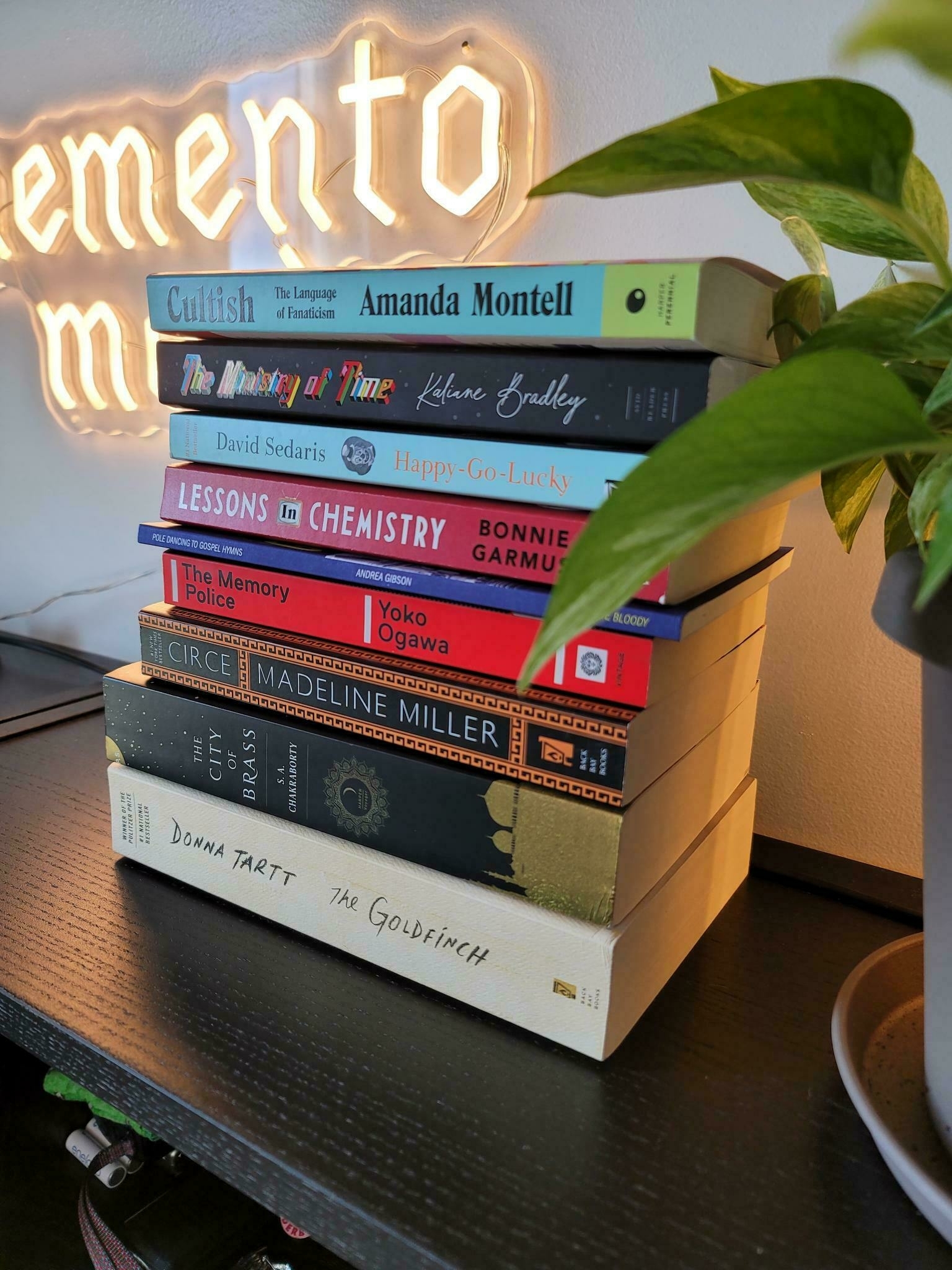
Overall this week… went pretty well. We got some rain - too much really - in the beginning of the week and I absolutely loved it. On Friday, Ria and I dressed up in our costumes (Howl and Sophie from Howl’s Moving Castle) and went into Frankfort. I got to achieve a lifelong dream of walking into my favorite indie bookstore and buy whatever books I fucking felt like it. I walked out with about 9. In my quest to get off of screens more, I’ve been reading a lot more and quickly discovered a dearth of fiction and memoir/essay in my collection.
Speaking of which, I finished the Lemire run of Moon Knight this week and absolutely loved it. I think overall the plural representation is really well done and the art styles are incredibly fun. I’d genuinely recommend it to anyone who’d interested in some plural/DID rep or who just loved a good psychological superhero arc.
My work… Most of my “work” time this week was spent in Canva. I created a new daily page for myself to use in my Everbook system. Setting up each day from scratch was taking a too much energy and I wanted to have a reminder of my keystone routines since they’d started to fall by the way side. I really like the page I came up with and it’s certainly served it’s purpose this week. I also spent some time working on a planner set up for my mom. She is hemipalegic from her stroke a few years ago and has gone through a few systems that aren’t quite what she’s needed. I’m setting up a discbound system for her and designing some pages to go in it.
My important relationships… Biscuit is doing well overall. We got word a couple weeks ago that he’s got an enlarged heart which is likely the beginning stages of heart failure so he started a medication that should hopefully help him longer than he otherwise would. I don’t think it’s sunk in for us yet. We’ve been enjoying our time with him even more and the medications seem to be improving his health. Fingers crossed for a few more years with our best boy.
Ria is doing alright on the whole. She was hypomanic for a lot of August and September but has slid into more of a mixed episode than her usual depression. The tough part about her mixed episodes are that she’ll be pretty much normal until very suddenly there are big emotions. It’s been tough but I’m proud of her for doing what she can.
My health… My health has been so-so this week. I’ve been very fatigued lately so I’ve been trying really hard not to push it. I think when people read fatigued they read “really tired” but I mean proper fatigue, like laying on the bed fully clothed, too tired to get up in the middle of the day so all I can do is stare at wall for two hours level fatigued. It hasn’t been this bad in a while. I’m not totally sure why it’s gotten worse but thats ME/CFS for you.
My anxiety has also been quite bad. I get hit with wave of being convinced I have cancer and am gonna die in a few months - which nothing in my medical tests and appointments remotely suggests. I used to have this happen when I was younger (teens/early twenties) and I’m not sure why it’s back with such a vengeance. Thankfully, I have more tools to ride it out these days.
If we know each other, say hi! Feel free to reply here or send me an email - marzcorbeau@proton.me